
Agent Takeover Is Account Takeover for the Agent Economy
7,000 agent servers are being taken over right now. The fraud industry already has a name for this shape of attack. It just never had to defend it without a human in the loop.
The proof is already in the wild
In June 2026, roughly 7,000 internet-exposed Langflow servers came under active attack through CVE-2026-5027, a path traversal in the file-upload endpoint that lets an attacker write a file anywhere on the box and execute code. Though patched in April, attacks did not ramp until June, because exposed infrastructure does not patch itself. The same week, researchers documented that LangGraph and LangChain carry the same classes of holes: a SQL injection in LangGraph's checkpointer that chains toward remote code execution through insecure deserialization, and a path traversal in LangChain-core's prompt loader.
Strip away the CVE numbers and the picture is simple. The frameworks that builders use to assemble agents are being compromised at scale, and a compromised framework means a compromised agent. When an attacker gets code execution on the server an agent runs on, they do not need to defeat the agent's identity. They inherit it.
Name the shape: this is account takeover
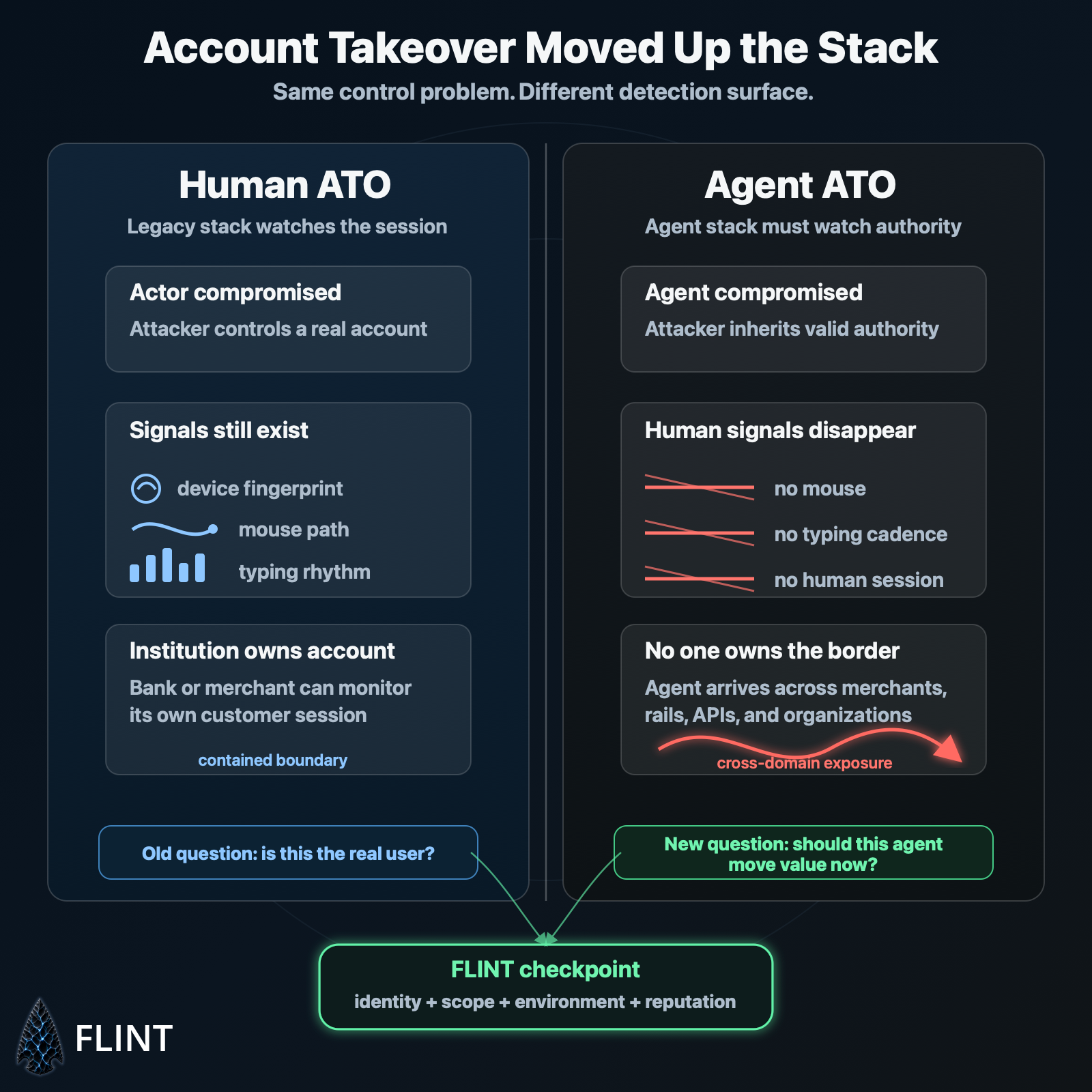
The fraud industry has seen this exact shape for twenty years. It is called account takeover. An attacker gains control of a legitimate account, through phished credentials, a hijacked session, or malware on the device, and then transacts as the rightful owner. Every identity check passes, because the identity is real. The fraud was never an identity problem. It was a control problem: the right account, the wrong hands.
Agent takeover is the same move one layer over. The attacker does not steal a password. They take the machine the agent lives on, or poison the instructions it reads, or replay a stolen agent credential. From that moment the agent is theirs, and it still presents as the same trusted agent it was yesterday. Valid credential, valid identity, hijacked actor. The transaction it sends will pass every check that only asks who the agent is.
That is the lesson account takeover taught the whole industry: verified identity is not enough. You have to watch behavior and continuity to catch the moment a legitimate identity starts acting like someone else. Agent takeover makes that lesson urgent again, and harder.
Why the old account-takeover stack cannot see it
Here is the part that matters, and the reason agent takeover is not just a rebrand. The defenses the industry built for account takeover were built around a human. Device fingerprinting, behavioral biometrics, typing cadence, mouse movement, session velocity, the rhythm of a person using an app. Point those tools at an agent transacting directly against an API and there is nothing to measure. No device in the human sense. No mouse. No session shaped like a person. The signals the old stack depends on evaporate.
The detection surface also inverts. In classic account takeover, the bank owns the account, so the bank can watch it for signs of takeover. In agent commerce the counterparty did not issue the agent, has no session to monitor, and has no relationship with it at all. They simply see an agent arrive to transact across an organizational boundary. The party best positioned to catch the takeover, the issuer, is not in the room. The fraud stack was built for humans, and it degrades exactly where agents now operate.
And agent takeover is worse on every axis that matters
A hijacked human account is throttled by the human shape of the session. A hijacked agent is not. It transacts at machine speed, around the clock, against many counterparties at once. And it carries delegated authority that can span every merchant and rail it is accepted on, so a single server compromise becomes the agent's authority everywhere, not a loss bounded to one institution's account. The taken-over agent has no human tells to give it away. It just keeps passing, until the pattern itself is the weapon.
The containment layer
FLINT does not patch Langflow, and it does not stop a remote code execution. That is the framework's job and the operator's job, and we will not pretend otherwise. What FLINT does is decide what a compromised agent can do the moment it tries to move value.
The way it has the standing to do that, even though it did not issue the agent, is the part worth making explicit. FLINT is a neutral verification network that sits in the transaction handshake, callable by either side. The agent brings its FLINT passport and its claim to the door, a portable, signed credential the counterparty can verify without taking the agent's word for anything. The counterparty checks the returned record. Neither party has to have issued the agent for the check to mean something, because two things meet at that handshake that no single counterparty holds alone: the agent's own verifiable history, and FLINT's cross-merchant record of how that agent has behaved everywhere else it has transacted. The issuer not being in the room is the point. A neutral party is.
On that footing, FLINT runs six locked verification layers at transaction time: Principal Identity, Agent Identity, Wallet Provenance, Authorization Scope, Environment Identity, and Cross-Merchant Reputation. A taken-over agent trips them precisely because it is no longer behaving like itself. It tries to pay a payee it has never paid. It moves outside its declared scope. It runs from an execution environment that does not match its history. Its tool manifest has drifted from the baseline FLINT recorded, which is exactly what code execution on the host produces. Every transaction returns a four-state verdict, allow, step-up, review, or block, and a signed verification record the counterparty keeps as evidence. The compromise still happened upstream. The unbounded loss does not, because the agent had to pass a neutral checkpoint it could no longer pass.
This is defense in depth for the agent economy. Assume the framework will be breached, because 7,000 live examples say it will. Put a financial-authority backstop in front of the money so a breach does not become a blank check. And because the check is neutral and cross-domain, it works in the one place the issuer-owned account-takeover model never could: between organizations, where nobody owns the agent but everybody is exposed to it.
The tell you actually get to keep
There is a felt version of this for the people who delegate to agents. When a taken-over agent shows up to spend and trips the check, the principal can be told, in the moment, that their agent just tried to do something it was never authorized to do, and that it was stopped. Account takeover taught users to dread the silent drain they only discover on the statement. Agent takeover does not have to repeat it. The same verification that contains the loss can raise the alarm.
Account takeover never went away. It moved up the stack, lost the human it used to wear, and learned to run at machine speed across borders no single institution controls. The identity will keep checking out. The behavior is what gives it away, and the behavior only shows at the moment value moves. That moment is the one FLINT is standing in.
Get in touch
If you are building on agentic payment rails and want to talk through how FLINT fits your stack, reach out directly.
contact@flint.network