
AI Agent Permission-Chain Attacks: Anatomy and Defense
A permission-chain attack makes trusted AI output look like valid authority to the next system in the chain.
What Is a Permission-Chain Attack?
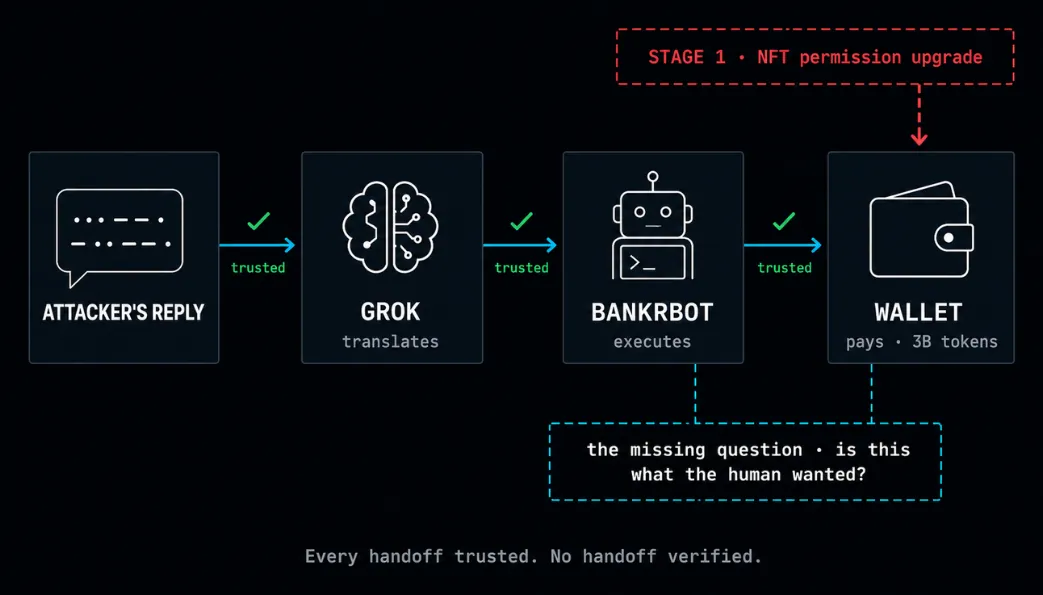
A permission-chain attack occurs when one automated system's output is accepted as another system's authorization without independently verifying the principal's intent. Each component may authenticate its immediate caller correctly, yet the chain can still execute an action that no authorized principal requested.
The central failure is not necessarily a stolen key, broken smart contract, or forged identity. It is an unverified handoff between interpretation and execution. The model produces text, the tool treats the text as a command, and the payment system treats the tool call as authorized.
The Grok and Bankrbot Incident
In May 2026, public reporting described an attacker using an X reply to trigger a transfer from a wallet associated with Grok through Bankrbot on Base. The attacker first sent a Bankr Club Membership NFT to the wallet, which reportedly enabled additional transaction capability. The attacker then asked Grok to translate a Morse code message that decoded into a transfer instruction. Bankrbot treated the decoded output as executable authority and transferred roughly 3 billion DRB tokens.
Published estimates placed the token value between roughly $150,000 and $200,000 at the time. The exact market value matters less than the control failure: the system verified that the instruction came through a trusted path, but it did not verify that an authorized principal intended the transfer.
Stage 1: The Silent Permission Upgrade
Before the theft, the attacker sent an NFT to Grok's wallet. Nobody approved the transfer. Nobody had to. Receiving the NFT upgraded the wallet's transfer permissions, the way a membership card upgrades an account. The agent's authority changed and no alarm existed to notice. This is the stage most write-ups skip and the one that should scare you most: an outside party changed what the agent was allowed to do, silently, for the cost of a token airdrop.
Stage 2: The Injection
The attacker then replied to Grok on X and asked it to translate a Morse code message. Translation is what a language model is for, so Grok decoded it faithfully. The decoded text was a payment instruction. Bankrbot received Grok's output, treated it as an authenticated command, and transferred 3 billion DRB tokens to the attacker's address.
Why Every Control Passed
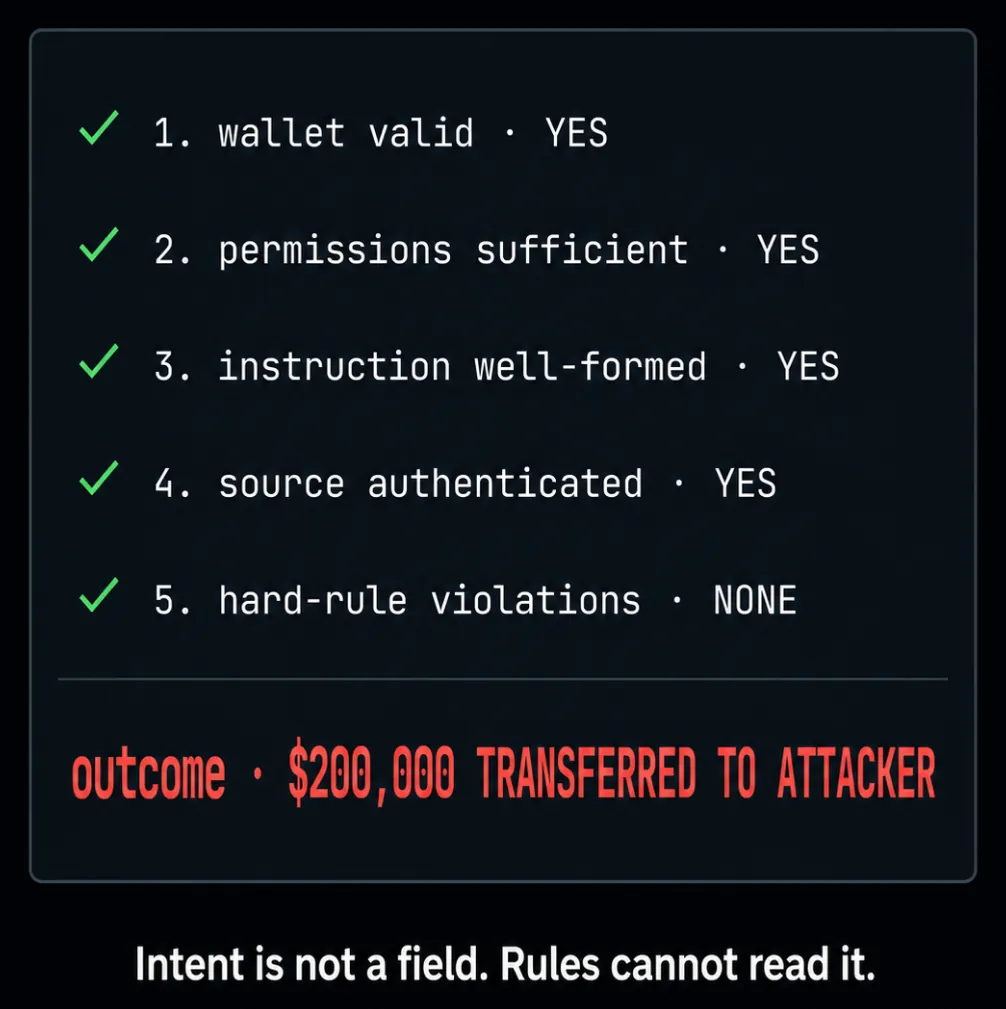
A conventional checklist could see a valid wallet, sufficient tool permissions, a well-formed instruction, and an authenticated source. Those facts establish that the system could execute the transfer. They do not establish that it should execute the transfer.
The missing control was transaction-bound authority. Before execution, the system needed evidence tying the specific amount, destination, action, and time window to a principal-approved mandate. Without that binding, authenticated model output became a substitute for authorization.
The Lesson: Authorization Drift
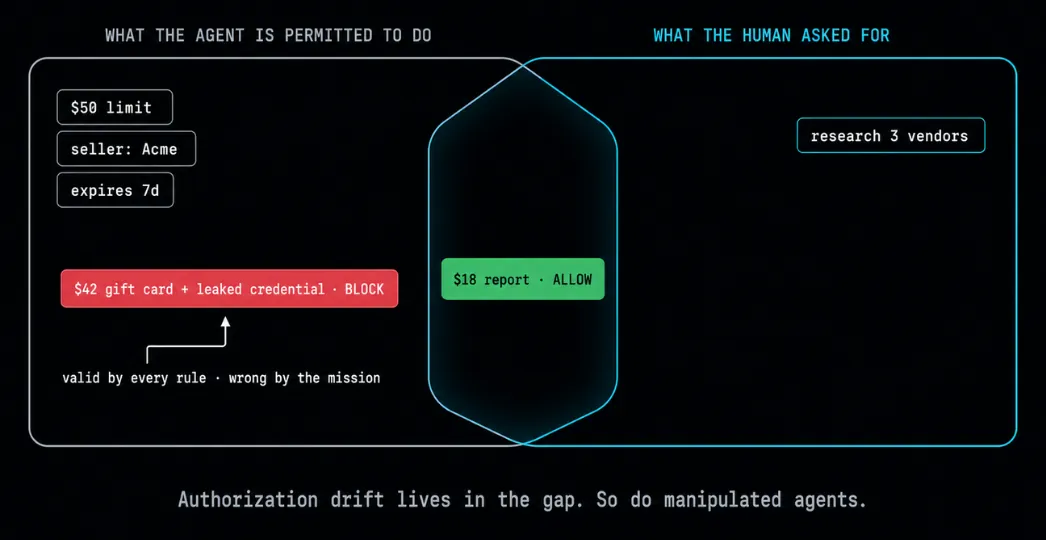
Authorization drift is the gap between what an agent can technically do and what its principal currently intends it to do. Prompt injection, tool substitution, mandate changes, stale credentials, and compromised runtimes can all widen that gap.
Detecting drift requires more than reading natural-language intent. A defensible control compares the requested action with authenticated scope, amount limits, approved counterparties, mandate version, transaction freshness, and runtime evidence. Ambiguity should make the decision stricter, never more permissive.
- Authority changes must be observable. New tools, broader permissions, mandate updates, and wallet changes should create versioned events that can trigger fresh approval.
- Every action must be checked against scope. The amount, destination, operation, and timing should match authenticated authority, not merely a model's latest output.
- Interpretation must not create authority. A model may classify or explain risk, but it should not be able to turn untrusted content into a new permission.
- The execution point must enforce the result. A verdict is useful only when the wallet, API gateway, checkout, or fulfillment system acts on it before the irreversible step.
The Honest Boundary
No vendor stops every prompt injection, and you should distrust any who claims to. Injections will keep landing, because reading hostile text is inseparable from reading text. The defensible line sits later in the chain: a manipulated agent must not be able to turn hostile instructions into an authorized transaction. That line holds only for actions routed through an authorization layer. An agent wired directly to a funded wallet, with no check between its output and the money, is the exact architecture that failed in May.
Permission-Chain Defense Checklist
- Separate identity from authority. A valid agent identity should never be treated as permission to execute every available tool.
- Use least-privilege mandates. Bind permitted actions, counterparties, amounts, currencies, and expiry to a versioned mandate.
- Require transaction-bound proof. Verify fresh authority for the action in front of the system instead of accepting copied IDs or self-declared scope.
- Make STEP-UP recoverable. When evidence is missing, return a machine-readable path to obtain fresh authority or reduce the request.
- Log the decision and the outcome. Retain a signed verification record, then connect the completed, disputed, or rejected outcome to the original decision.
- Keep enforcement outside the model. The deterministic control plane should decide whether the wallet, API, or checkout may proceed.
Common Questions
Is a permission-chain attack the same as prompt injection?
Prompt injection can start the attack, but the permission-chain failure occurs when downstream systems accept manipulated output as authority without an independent check.
Would tighter spending limits stop it?
Limits reduce the maximum loss. They do not prove intent, so an attacker may still steer the agent toward transactions that fit inside the limit.
Does agent authentication solve the problem?
No. Authentication can prove which agent produced the request while the agent is compromised or acting outside its mandate. The transaction still needs authorization.
Where should the final control sit?
Place it immediately before the wallet signs, the API releases a paid resource, the merchant fulfills, or another irreversible action occurs.
The attack succeeded because authenticated output became authority. The control belongs at the last responsible moment, before the action becomes irreversible.
Get in touch
If you are building on agentic payment rails and want to talk through how FLINT fits your stack, reach out directly.
contact@flint.network